Wildlife at Conga
Wildlife at Conga: A Field Guide to Our Garden
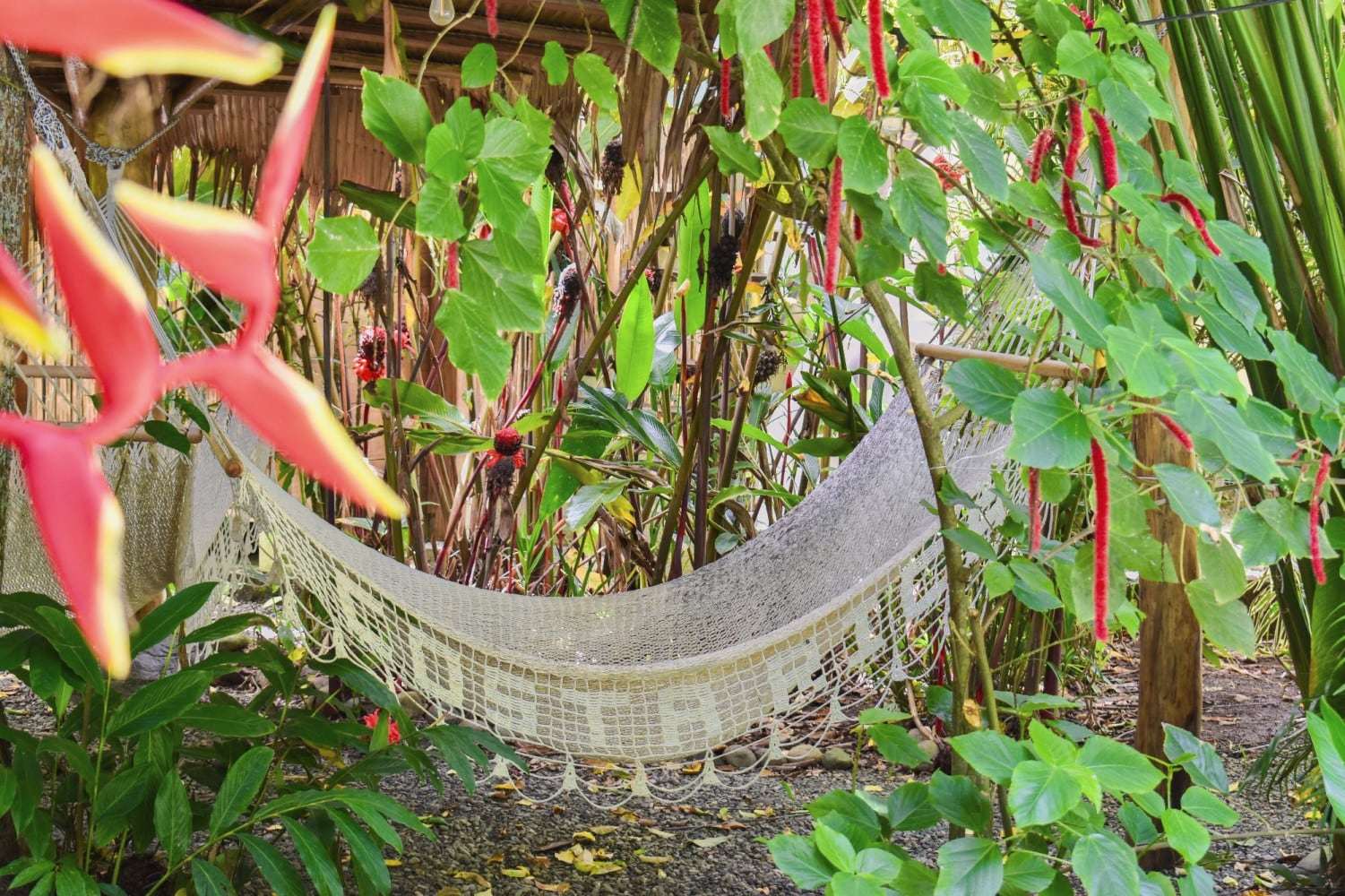
Our garden is part of the forest, and the forest comes to visit. Guests have spotted sloths, toucans, poison-dart frogs, agoutis and iguanas without leaving the hotel. Here’s how to find them, and how to watch without disturbing them.
“We saw more wildlife here than in the National park.”
Field guide
Who you might meet
These are animals guests have seen in our garden, with a few facts from the field guides. Sightings are never guaranteed.
Sloths · perezosos
Two species live on this coast. The brown-throated three-toed sloth is active by day and night, about 8 to 10 hours a day; Hoffmann’s two-toed sloth is mostly nocturnal and comes down to the ground only about once a week. When to look: any time; scan the crowns of tall trees.
Toucans · tucanes
The keel-billed toucan measures about 52 cm, with a bill up to a third of its body length. The yellow-throated toucan’s call is often rendered as “Dios te dé”, “God give you”. When to look: mornings and late afternoon, in fruiting trees.
Poison-dart frogs · ranas venenosas
Guests have spotted green-and-black poison-dart frogs here; the male carries the tadpoles on his back to water. The strawberry poison-dart frog, usually red with blue legs, also lives around Puerto Viejo. When to look: by day on damp ground, especially after rain.
Red-eyed tree frog · rana calzonuda
A creature of the night. Eggs are laid on leaves above water; after 4 to 6 days they hatch, and the tadpoles drop into the water below. When to look: after dark, near water, often in the rainy season.
Agoutis · guatusas
The Central American agouti forages by day and buries seeds as food caches, which helps spread many forest trees. When to look: by day, on the ground; move slowly and quietly.
Iguanas · iguanas verdes
Green iguanas bask in the branches on sunny mornings. Nearby in Këköldi, the Wak Ka Köneke association runs an iguana breeding project. When to look: sunny mornings, up in the trees.
Tips
When and where to look
Slow down and look up. Sloths spend their lives in the treetops and move slowly; algae can even give the three-toed sloth’s fur a green tint. Toucans are easiest to find in the morning and late afternoon, when they visit fruiting trees.
Frogs are ground-level, after-rain animals: scan damp leaf litter by day for poison-dart frogs, and bring a small flashlight after dark for tree frogs. Agoutis forage on the ground in daylight, and iguanas bask on sunny mornings.
Sightings are never guaranteed. Ask at reception whether anyone has spotted something today.

Watch without harm
- Don’t touch or feed wild animals. In Costa Rica it’s against the law.
- Never pick up a frog. Watch and photograph from a distance, and keep children’s hands off.
- Keep your flash off and your voice low, especially at night.
- Don’t use food, calls or recordings to attract animals.
- Stay on the paths after dark and watch where you step.
- If you find an injured animal, don’t handle it. Tell our reception team.
Where else can you see wildlife?
The Jaguar Rescue Center, about 3.4 km away near Playa Chiquita (roughly 5 minutes by car or 15 by bike), cares for injured, orphaned and confiscated wild animals native to Costa Rica. Guided public tours run daily at 9:30 and 11:30 am and last about 1.5 hours; children under 10 enter free. Check current prices and tickets on the center’s website.
Cahuita National Park, about 20 minutes’ drive north, lists howler monkeys, white-faced capuchins, sloths, coatis and toucans among its wildlife. To the south, the Gandoca-Manzanillo Wildlife Refuge has recorded 377 bird species.
For frogs and other animals of the night, join a guided rainforest night walk.
Go further
Rainforest night walk
A guided walk on rainforest trails after dark with a specialist guide, looking for frogs and other night animals.
Learn moreWhere to see sloths in Puerto Viejo
Our guide to watching sloths in the wild around Puerto Viejo, and doing it responsibly.
Learn moreAll tours
Dolphins off Manzanillo, reef snorkeling, Punta Mona and more, arranged by our team.
Learn more
“Surrounded by nature, you can hear only birdsong… you can also observe the toucans.”
Wildlife questions
When is the best time to see sloths at Conga?
There’s no fixed hour. Brown-throated three-toed sloths are active by day and by night, while Hoffmann’s two-toed sloths are mostly nocturnal, so any time can work. Look slowly through the crowns of the tallest trees, and ask at reception whether one has been seen that day. Sightings are never guaranteed.
Are the poison-dart frogs dangerous?
Not if you leave them alone. Their bright colors advertise toxins in their skin: about 90 alkaloids have been identified from the green-and-black poison-dart frog. Watch and photograph them from a distance, never pick one up, and keep children’s hands off. Touching wild animals is also against Costa Rican law.
Sources
- Animal Diversity Web, Bradypus variegatus (brown-throated three-toed sloth)
- Animal Diversity Web, Choloepus hoffmanni (Hoffmann’s two-toed sloth)
- Animal Diversity Web, Ramphastos sulfuratus (keel-billed toucan)
- Wikipedia, Yellow-throated toucan
- Animal Diversity Web, Dendrobates auratus (green-and-black poison-dart frog)
- Animal Diversity Web, Oophaga pumilio (strawberry poison-dart frog)
- Animal Diversity Web, Agalychnis callidryas (red-eyed tree frog)
- Animal Diversity Web, Dasyprocta punctata (Central American agouti)
- Animal Diversity Web, Iguana iguana (green iguana)
- The Tico Times (Oct 13, 2006), Këköldi Wak Ka Köneke
- Jaguar Rescue Center, Public Tour
- SINAC, Parque Nacional Cahuita
- SINAC, Refugio Nacional de Vida Silvestre Gandoca-Manzanillo
Wake up in the garden
Breakfast in the garden is included with every stay. Bring binoculars.